


07 Jul 5 Promising Stocks in Alopecia Areata
Alopecia Areata is an autoimmune/polygenic skin disease that causes loss of hair on the scalp and face and is estimated to affect over 6.8 million people in the U.S alone. There is currently no cure available for this disorder, with dermatologists using Corticosteroids, minoxidil 5%, Anthralin and Diphencyprone (DPCP) as treatment options. However, these cause discomfort and side effects leading to low patient adherence. Alopecia areata is one of eight new disease areas selected by the FDA in 2015 that it will focus on under its Patient-Focused Drug Development Initiative (PFDDI).
This disorder can cause a severe emotional impact on the patient as it has social implications and can lead to isolation and stigma, it may even adversely affect the ability to form and sustain relationships. The alopecia industry has faced challenges in achieving proof of concepts (PoC), as patient responses to therapy are highly individualized with some of them experiencing spontaneous remission. However recent scientific advancements have shown that new research such as T-cell mediated mechanisms can achieve faster PoC’s.
A report by Grand View Research, estimates that the global alopecia treatment market will reach USD 11.8 Billion by 2024. The rise in disposable incomes, increasing health awareness being made possible by organizations such as National Alopecia Areata Foundation (NAAF) and the American Hair Loss Association, and the rise in research and development efforts will propel the growth in the market. Many branded products are heading towards patent expiry that could attract an onslaught of generics and act as a hindrance for further innovation.
Tropical applications are the most preferred form of treatment because of their ease of use and non-invasive nature; however, the introduction of novel treatment options such as Janus kinase inhibitors (JAK) that can stimulate follicle growth with minimal side effects have the potential to change the therapeutic market. The cost of treatment is still deemed prohibitive and can hamper the growth rate of the industry.
Concert Pharmaceuticals Inc (NASDAQ: CNCE)
Market Cap: $125.48M; Current Share Price: 3.90 USD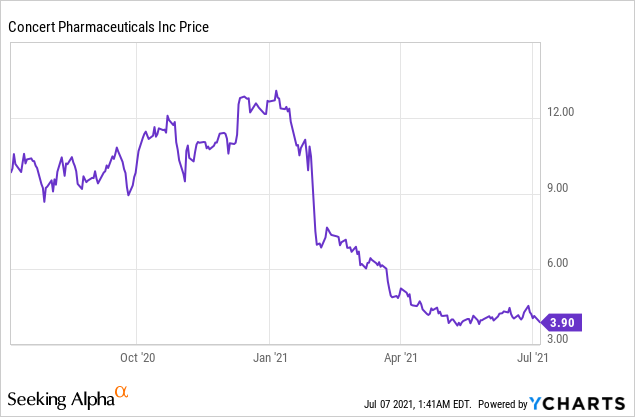
Data by YCharts
Concert Pharmaceuticals is leveraging its proprietary DCE Platform® (deuterated chemical entity), to improve the pharmacokinetic or metabolic properties of approved drugs, in the field of autoimmune and central nervous system disorders. The company intends to capitalize on its ability to create deuterated versions of known drugs, thereby achieving faster clinical proof-of-concept and clinical success on one hand, and enhanced oral bioavailability, improved metabolic profile and longer half-life of the compounds on the other.

Image Source: Company
Deuterium is non-radioactive and safe and can be isolated from sea water. It is naturally occurring in abundance, even in the human body, and hence used in human and metabolic studies. It possesses double the atomic mass of hydrogen which enables it to form potent bonds with carbon and makes it an ideal candidate for drugs that are metabolized by pathways characterized by scission of carbon-hydrogen bonds.
It is developing CTP-543 an oral selective inhibitor of certain Janus kinases, known as JAK1 and JAK2 for treatment of Alopecia, by modifying ruxolitinib being marketed in the U.S under the brand name Jakafi® for the treatment of myelofibrosis and polycythemia vera which is currently undergoing Phase 3 clinical trials namely THRIVE-AA1 and THRIVE-AA2. The candidate has been granted a breakthrough therapy designation and a fast-track designation by the FDA.

Image Source: Company
Concert is currently enrolling patients in the Phase 3 trial and is expecting to announce the results from the Phase 3 trial in 2022. Positive results from the trial will serve as a basis of filing for a New Drug Application (NDA) in early 2023.
The company’s novel DCE Platform® is protected by 113 issued US patents or patent applications that claim deuterated analogs of more than 90 non-deuterated drugs and drug candidates. The company has strategic collaborations with leading biopharmaceutical companies such Jazz Pharmaceuticals for the development of a once nightly sodium oxybate product and Avanir pharmaceuticals for developing AVP-786, which is currently being evaluated in several phase 2 and phase 3 clinical trials for treatment of neurologic and psychiatric disorders.
The company also has an Asset purchase agreement with Vertex for VX-561 (previously known as CTP-656), an investigational cystic fibrosis transmembrane conductance regulator (CFTR) potentiator. In 2017, Concert received a one-time cash payment of $160 million, followed by $32 million in May 2021, in lieu of all potential future milestones payments from Vertex Drugs.
Concert has also entered into a licensing agreement with Cipla, for grant of worldwide rights to CTP-354, a GABAA receptor subtype-selective modulator, intended for the treatment of spasticity and other CNS disorders. The Company also has a licensing agreement with Processa Pharmaceuticals for the worldwide rights to CTP-499, a deuterated analog of 1-(S)-5-hydroxyhexyl-3,7-dimethylxanthine, an active metabolite of pentoxifylline
AnaptysBio Inc (NASDAQ: ANAB)
Market Cap: $707.02M; Current Share Price: 25.65 USD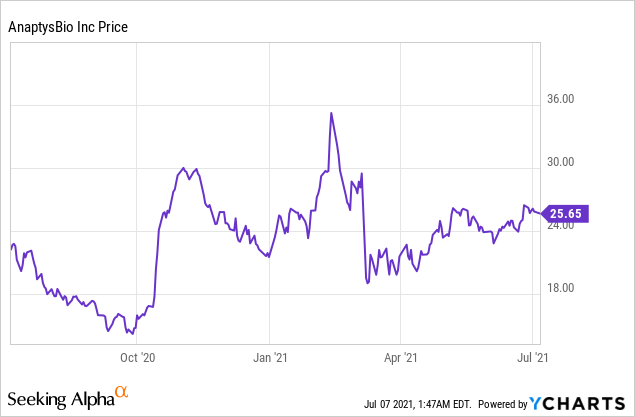
Data by YCharts
AnaptysBio is developing a pipeline of therapeutics antibodies to combat severe diseases, by leveraging its proprietary antibody discovery technology platform, based on somatic hypermutation. The Company’s novel platform replicates the natural process of somatic hypermutation (SHM), an endogenous process which aids in the creation of essential antibody diversity to mount a response against pathogens. The Company’s approach is to expand the diversity of the human genome, which contains a limited number of antibody genes that are not potent enough to produce a response against pathogens.
The Company is using the activation-induced cytidine deaminase, or AID in combination with the mammalian cell system and is able to identify and mature antibodies to high potency, that offers several advantages such as ability to develop antibodies for difficult, previously unaddressed targets, high potency and speed of manufacturing among others.
AnaptysBio’s lead candidate for the treatment of Alopecia Areata is ANB030, an anti-PD-1 agonist, which is currently undergoing phase 1 clinical trials and is expected to advance to Phase 2 trials in Q4,2021. The topline data from the phase 1 trial is expected to be made available in the second half of 2021. The Company has presented ex vivo translational data showing activity of ANB030 in peripheral blood mononuclear cells (PBMCs) in patients suffering from alopecia areata at the Festival of Biologics Conference in March 2020. The candidate is currently being evaluated in healthy subjects as part of Phase 1 study designed to evaluate the safety, pharmacokinetics and pharmacodynamic activity of ANB030.

Image Source: Company
The Company’s pipeline also consists of Imsidolimab (ANB019), intended for the treatment of Generalized Pustular Psoriasis, Palmoplantar Pustulosis, EGFRi-Mediated Skin Toxicity, Ichthyosis, Acne Vulgaris and hidradenitis Suppurativa. ANB032, an Anti-BTLA Modulator is being developed for the treatment of inflammatory diseases, JEMPERLI (dostarlimab) for dMMR Endometrial Cancer, dMMR Pan-Tumor and Ovarian cancer, besides candidates for the treatment of NSCLC, Immuno-oncology indications and Inflammation.
In April 2021, the Company received conditional marketing authorization for JEMPERLI (dostarlimab) for treatment of mismatch repair deficient (dMMR)/microsatellite instability-high (MSI-H) recurrent or advanced endometrial cancer in women, who have progressed on or following prior treatment with a platinum containing regimen, making it the first anti-PD-1 therapy for the condition in Europe.
The Company also announced the approval of GSK’s Biologics License Application (BLA) for JEMPERLI (dostarlimab-gxly) by the FDA in April 2021. The candidate was generated using the Company’s somatic hypermutation (SHM) antibody platform and later developed by TESARO, Inc., which became a part of GSK. This is the first AnaptysBio-generated antibody to obtain FDA approval and serves as a validation for the Company’s technology.
Bioniz Therapeutics (Private)
Bioniz is using its expertise in multi-cytokine modulation to create novel therapeutics for immune disorders. The Company’s proprietary technology namely Multi Modal Modulation (M3), enables the creation of cutting-edge anti-cytokine therapeutics that can not only inhibit cytokines but also maintain the normal functioning of the immune system. The Company’s approach consists of using rationally-designed peptides selectively blocking specific cytokines, without interfering with the healthy -cytokine network.

Image Source: Company
Bioniz’s lead candidate BNZ-1 is a multi-cytokine inhibitor of IL-2, IL-9 and IL-15, which can be used to potentially treat numerous dermatological disorders such as alopecia areata, vitiligo, and cutaneous T-cell lymphoma (CTCL).
BNZ-1 is targeting the treatment of Alopecia areata by complete inhibition of IL-2, IL-15, and IFN-γ. In preclinical studies, the candidate has demonstrated a significant decrease in cytotoxic CD8 T-cell activation, along with reduced number of activated cytotoxic CD8 cells and durably reversed hair loss. The Company believes that the candidate has the potential to selectively and completely inhibit the pathways responsible for causing alopecia areata, and intends to advance the candidate to a phase 2 trial.
In April,2021 the Company received an orphan drug designation for BNZ-1, a selective inhibitor of cytokines IL-2, IL-9, and IL-15, being developed for the treatment of a rare form of skin cancer, namely cutaneous T-cell lymphoma (CTCL) by the European Commission. The candidate was earlier granted an orphan drug designation by the FDA and has completed a phase 2 study in CTCL. The Company intends to initiate a phase 3 trial in patients with relapsed or refractory CTCL (rCTCL) and commence enrollment of patients in the second half of 2021.
The Company is also developing BNZ-2, an IL-15/21 Inhibitor, intended for the treatment of Celiac Disease and an IL-15/21 Inhibitor BNZ-3 for oral administration in immune mediated diseases of the GI tract.
Arena Pharmaceuticals (NASDAQ: ARNA)
Market Cap: $4.23B; Current Share Price: 69.69 USD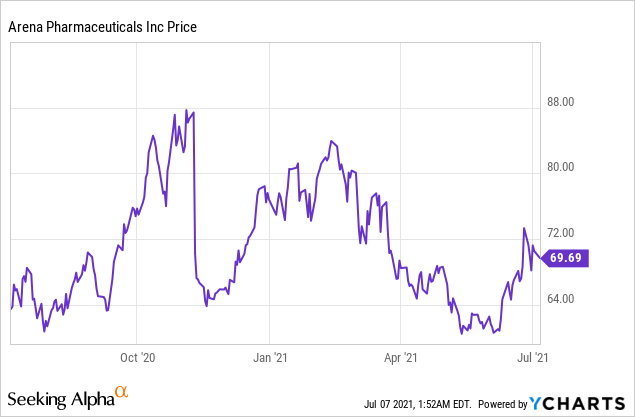
Data by YCharts
The Company’s lead drug candidate for the treatment of Alopecia Areata is ETRASIMOD, a once-daily, oral, selective S1P receptor modulator that has the potential to reversibly reduce lymphocyte levels at the inflammation site, with minimal effect on the immune function. The candidate is currently being evaluated in multiple clinical trials for treatment of indications such as ulcerative colitis (ELEVATE and GLADIATOR), Crohn’s Disease (CULTIVATE) and eosinophilic esophagitis (EoE) (VOYAGE).
In addition, the Company’s pipeline consists of a phase 2 trial named CAPTIVATE, evaluating OLORNINAB for the treatment of irritable bowel syndrome. Furthermore, Arena’s cardiovascular pipeline has two candidates in phase 2 trials namely APD418 for Acute Heart Failure and Temanogreal for Coronary Microvascular Obstruction.
In September 2020, Arena dosed the first patient in a phase 2 trial evaluating etrasimod for the treatment of moderate-to-severe alopecia areata. The subjects will be administered with a 2mg dose over 24 weeks to evaluate its safety, efficacy and tolerability. The primary endpoint of the study is change in Severity of Alopecia Tool (“SALT”) score from baseline. The results from the trial are expected to be released in 2021.
The Company is focusing on creating innovative therapeutics in the areas of Gastroenterology, Dermatology and Cardiovascular health. Arena is developing an early-stage immune and inflammatory platform named Project Cabrillo in association with Beacon Discovery to develop therapeutics across a range of G protein-coupled receptor (GPCR) targets. The Company also has an agreement with Boehringer Ingelheim for the development of an undisclosed Orphan GPCR for treatment of central nervous system indications that is currently undergoing preclinical development. Arena is also collaborating with United Therapeutics for the development of RALINEPAG, which is currently being evaluated in a phase 3 trial for the treatment of pulmonary arterial hypertension.
In October 2020, the Company founded an independent company Longboard Pharmaceuticals, previously known as Arena Neurosciences, to advance therapies for rare neurological diseases.
Arcutis Biotherapeutics Inc (NASDAQ: ARQT)
Market Cap: $1.28B; Current Share Price: 25.44 USD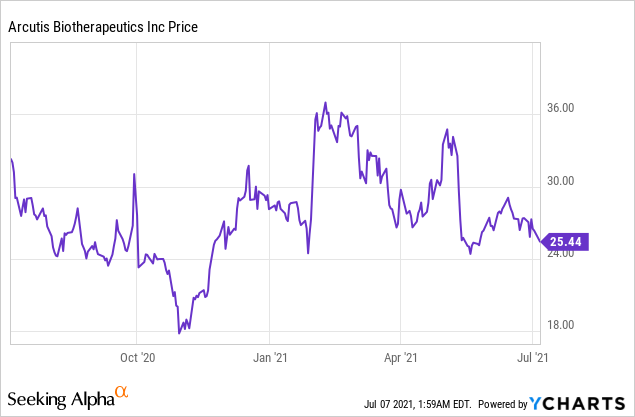
Data by YCharts
The Company’s approach revolves around the use of a topical JAK Inhibitor, delivered directly to the site of inflammation, deep into the bulb of the hair follicle. Arcutis is developing ARQ-252, as an alternative topical formulation of ARQ-252, a topical JAK1 inhibitor that has the potential to address the treatment of various inflammatory dermatological diseases such as eczema and vitiligo, besides alopecia areata. Arcutis is currently working on the formulation and preclinical activities and will advance the candidate into clinical trials upon successful completion of the same. The candidate has the potential to become the only topical treatment for alopecia areata.
The candidate acts by inhibiting the JAK pathway, JAK1 in particular, that plays a key role in immune system function. The targeting of this pathway has the potential to treat a wide range of inflammatory diseases like rheumatoid arthritis, psoriasis, Crohn’s disease, and atopic dermatitis among others.

Image Source: Company
ARQ-252 offers more potency and high selectivity against JAK1 as compared to JAK2, which makes it much safer than other topical JAK inhibitors. The candidate is currently being evaluated in a phase 1/2b in adult patients with chronic hand eczema and the results from the study are expected to be released by mid-2021. In addition, the Company initiated enrollment of patients in a Phase 2a clinical trial in vitiligo, the results from which are expected to be announced in the second half of 2023.
The Company has entered into a licensing agreement with AstraZeneca for exclusive worldwide rights to the topical dermatological use of roflumilast, a small molecule inhibitor of phosphodiesterase type 4 (PDE4), intended for the treatment of chronic plaque psoriasis and atopic dermatitis. The Company has reported positive phase 3 data from a trial in plaque psoriasis in February 2021, and is planning to file a New Drug Application (NDA), in the second half of 2021.
In December 2019, Arcutis exercised its option under a 2018 licensing agreement with Jiangsu Hengrui Medicine Co., Ltd. of China for the active pharmaceutical ingredient in ARQ-252, for use in the United States, Canada, Europe and Japan.
In January 2021, Arcutis initiated a Phase 3 trial in atopic dermatitis named INTEGUMENT-1 and INTEGUMENT-2 and is likely to announce the results from the study in the second half of 2022.
Disclosure: I/we have no positions in any stocks mentioned, and no plans to initiate any positions within the next 72 hours.
Click here to please visit our detailed disclosure
References
https://www.concertpharma.com/wp-content/uploads/2021/06/Concert-Corporate-Fact-Sheet-JUNE2021.pdf
https://ir.concertpharma.com/static-files/0e5d8c25-28a8-486e-8055-f2ab31b0cece
https://www.anaptysbio.com/technology/#somatic-hypermutation
https://arcutis.com/trial/arq-252/
https://arcutis.com/who-we-are/leadership/#sec-4-spot
https://investors.arcutis.com/static-files/83b29522-745d-457b-9b6b-4e78ad293bac

No Comments