


09 Jun Biogen Scores a Big Win for ADUHELM™, But the Path Ahead Isn’t Easy!
Biogen, Inc. (NASDAQ: BIIB) ADUHELM™ (aducanumab-avwa), scored an approval from the U.S. Food and Drug Administration (FDA), to become the first drug approved after 2003 for the treatment of Alzheimer’s disease, which specifically addresses the underlying cause of the disease, by removing amyloid beta from the brains of those afflicted with the condition.
Aducanumab is a human recombinant monoclonal antibody (mAb), which was originally developed by Neurimmune as part of an agreement with Biogen in November 2007. Neurimmune used its Reverse Translational Medicine platform to identify and develop Aducanumab (BIIB037), which uses (mAb) derived from aged donors who are healthy and have no cognitive impairment. The drug targets amyloid plaque in the brain of patients suffering from Alzheimer’s.
Biogen, Inc. (NASDAQ: BIIB)
Market Cap: $ 59.53B; Current Share Price: 395.37 USD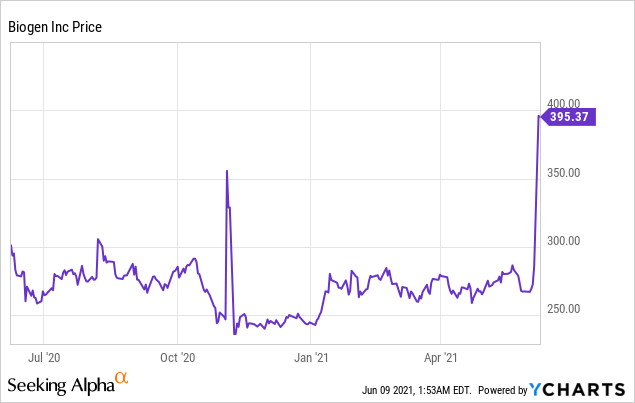
Data by YCharts
Michel Vounatsos, Chief Executive Officer at Biogen commented,
“This historic moment is the culmination of more than a decade of ground-breaking research in the complex field of Alzheimer’s disease. We believe this first-in-class medicine will transform the treatment of people living with Alzheimer’s disease and spark continuous innovation in the years to come. We are grateful for the contributions of thousands of patients and caregivers who participated in our clinical trials, as well as for the dedication of our scientists and researchers. Together with the healthcare community, we are ready to bring this new medicine to patients and begin to address this growing global health crisis.”
In 2017, the Company entered into collaboration with Eisai to jointly develop and commercialize the candidate globally. Aducanumab was granted a FastTrack Designation in April 2017 by the FDA and was accepted into the PRIME program in August 2016 by the European Medical Agency. In addition, the candidate was also accepted into the Sakigake Designation System by the Japanese Ministry of Health, Labour and Welfare (MHLW) in April 2007.
The Company has submitted marketing authorizations for aducanumab in Brazil, Canada, Switzerland and Australia. In addition to aducanumab, the Company is also developing lecanemab (BAN2401), which is currently in development for the treatment of patients in early Alzheimer’s disease and has recently enrolled the last patient in the clarity AD Phase 3 trial.

Image Source: Company
A Win marred by Controversy
The approval has met with criticism from several quarters which raises questions about its efficacy.
In March 2019, the Company had announced that it was halting two Phase 3 clinical trials of aducanumab, based on the results from an analysis conducted by an independent monitoring committee. The candidate was found to be unlikely to benefit patients when compared to a placebo. Aducanumab was believed to have the potential to remove beta-amyloid, a protein which is responsible for causing the damage. However, In October 2019, the Company decided to pursue a regulatory approval of the drug after discussion with the FDA and analysis of a larger data set, which showed reduced clinical decline in patients with early Alzheimer’s disease.
The Company also reported that the Phase 3 ENGAGE Study met its primary endpoint of significant reduction in clinical decline. Biogen reported that the additional data, which became available after the futility analysis, demonstrated the safety and efficacy of the drug. In August 2020, the Company’s Biologics License Application (BLA) for aducanumab was accepted by the FDA and was granted a Prescription Drug User Fee Act (PDUFA) action date on March 7, 2021.
In November 2020, the peripheral and central nervous systems drugs advisory committee voted no on many counts against the approval of the drug.
The FDA later extended the review period by three months to review additional analyses and clinical data, which was considered a major amendment to the application.
Industry
Alzheimer’s is the sixth leading cause of death in the U.S, a disease that causes irreversible degeneration of the brain cells and affects a person’s cognitive and behavioral abilities such as impaired judgment, deteriorating memory and personality changes with the gradual loss of motor abilities and speech.
According to some compelling statistics made available by Alzheimer’s Association over 5.8 million Americans are affected by this disorder and the numbers will most likely reach 14 million by 2050, with a new diagnosis being made every 65 seconds. The healthcare cost of Alzheimer’s and other Dementia related ailments will be over $290 billion in 2019, these numbers are likely to escalate further to over $1.1 trillion by 2050.

Image Source: NIH
A report by transparency market research predicts that the global market for Alzheimer’s will reach US$6.4 billion by 2025, growing at a CAGR of 7.5%, from US$3.6 billion in 2017. The rise in ageing population, increased awareness about the benefits of combined therapy, a favorable regulatory and government support environment are some of the factors that will contribute to the growth of the market. The economic burden of the disease on not only the patients but also caregivers will act as an impediment for the market. The prohibitive cost of expensive treatment especially in developing nations is another obstacle for growth.
Alzheimer’s is one illness, where innumerable attempts have been made to find a cure with no success. According to a report released by Pharmaceutical Research and Manufacturers of America (PhRMA) from 1998 to 2017 there have been about 146 failed shots at developing drugs for Alzheimer’s disease. However recent advancements in technology and the discovery of new molecules and combination therapies are offering renewed hope to those suffering from this illness.
Company
A pioneer in the Neuroscience industry, Biogen is one of the world’s first biotechnology companies spearheaded by a team, which includes Nobel Prize winners Walter Gilbert and Phillip Sharp. The Company’s focus is on developing novel therapies for neurological and neurodegenerative diseases such as multiple sclerosis (MS), Alzheimer’s, Parkinson’s and amyotrophic lateral sclerosis (ALS) to name a few. The Company has introduced the first and the only approved treatment for spinal muscular atrophy.
The Company’s pipeline consists of BIIB061 (Oral remyelination), an oral small molecule that stimulates the production of cells that produce myelin, a key protective sheath that covers nerve fibers and plays a crucial role in nerve communication. The candidate is currently undergoing a Phase 1 trial. In addition, the Company is also developing BIIB091, a selective inhibitor of Burton’s tyrosine kinase (BTK), which plays a key role in activation of Myeloid cells through (Fcγ receptor signaling (FcγRs)) and is currently undergoing a phase 1 trial.
In December 2017, the Company entered into a collaboration with Ionis to identify new antisense oligonucleotide (ASO) candidates, intended for the treatment of Spinal Muscular Atrophy (SMA). In April 2021, Biogen announced new data from clinical trials of SPINRAZA® (nusinersen).

Image Source: Company
The Company is working on expanding its gene-therapy capabilities by building a state-of-the-art gene therapy manufacturing facility, which is likely to be operational by 2023 and has multiple mid-to late-stage readouts in 2021, including a pivotal Phase 2 data readout for BIIB124 (SAGE-324) KINETIC study in essential tremor, which is being developed in collaboration with Sage Therapeutics. Biogen will also report the data from an interim analysis of Zurnolone (GABAA PAM) ^ SHORELINE from a phase 3 trial in MDD.
Biogen’s product portfolio consists of AVONEX® (INTERFERON BETA-1A), BENEPALI® (ETANERCEPT), FAMPYRA® (PROLONGED-RELEASE FAMPRIDINE TABLETS), PINRAZA® (NUSINERSEN), TYSABRI® (NATALIZUMAB) VUMERITY® (DIROXIMEL FUMARATE) among others.
Furthermore, the Company currently has 33 candidates under clinical development for multiple indications such as SB11 (biosimilar referencing LUCENTIS®) for ophthalmologic conditions, SB11 (biosimilar referencing LUCENTIS®) for ALS, BIIB093 (IV glibenclamide) for Large hemispheric infarction, BIIB111 (timrepigene emparvovec) for Choroideremia SB15 (biosimilar referencing EYLEA®) for Various ophthalmologic conditions, Dapirolizumab pegol (anti-CD40L) for Systemic lupus erythematosus BIIB104 (AMPA) for Cognitive impairment associated with schizophrenia (CIAS) and BIIB122 (LRRK2 SM) for the treatment of Parkinson’s disease among others.
Key Takeaways
The approval of ADUHELM™ (aducanumab-avwa) has brought much cheer to those suffering from Alzheimer, caregivers and patient advocacy groups. However, there are multiple concerns from efficacy to cost that plague the adoption of aducanumab. Firstly, the drug has to be administered through monthly infusions which might prove challenging, as patients would have to travel to the administration site, which is easier said than done, owing to logistical issues and availability.
The Company has committed to not raising the price of the drug for four years and is working on access deals with Veterans Health Administration, CVS Health and the National Association of Free and Charitable Clinics (NAFC), in addition to Cigna and other groups.
Secondly the drug is likely to cost USD 56,000 annually, which may be prohibitively expensive, even without taking into account the various authorisation and coinsurance requirements that would have to be met for obtaining coverage for aducanumab from Medicare and private players. The cost and the eligibility requirements will significantly bring down the number of patients who would be able to use the drug. In addition, the Centers for Medicare and Medicaid Services (CMS) is likely to pay close heed to the recommendations and objections of the AdCom, which voted 8-1 against the efficacy results from two Phase 3 studies namely EMERGE (NCT02484547) and ENGAGE (NCT02477800), while determining coverage.
Another major constraint for adoption is the cost of PET scans that are essential for evaluating the amyloid count, which cost nearly $5000 and are not covered under Medicare. In addition, the patients will also require regular MRI scans to check for amyloid-related imaging abnormalities (ARIA), which would add to the overall cost of treatment. However, there is a possibility of blood-marker tests being made available in the near-future, which could overcome this constraint.
According to an estimate by GlobalData the peak sales for aducanumab is to be around $4.1B in 2028 across eight major markets (8MM: US, France, Germany, Italy, Spain, UK, Japan and China). The absence of viable disease-modifying therapies (DMTs) and lack of any late-stage candidate from a competitor will drive the sales.
Disclosure: I/we have no positions in any stocks mentioned, and no plans to initiate any positions within the next 72 hours.
Click here to please visit our detailed disclosure
References
https://www.clinicaltrialsarena.com/comment/biogen-aducanumab-alzheimers-fda/
https://investors.biogen.com/static-files/a957e5ba-325f-4a37-bfc8-43cecfc64620
https://www.pharmaceutical-technology.com/comment/biogen-aducanumab-fda-approval/
https://www.globaldata.com/fda-likely-approve-biogens-aducanumab-review/

No Comments