


05 Aug Can Impinj make its mark in the IoT space?
Impinj, Inc. (NASDAQ: PI) is a premier cloud connectivity platform offering products and services which help provide wireless connectivity, and information pertaining to connected items, to numerous companies across the globe. The Company’s services are utilized by leading players in the retail, aviation, automobile, food, supply chain management, travel and banking sectors.
Through its partners, Impinj provides its products and services in countries across Europe, Asia Pacific, Middle East and Africa, besides the Americas.
Impinj, Inc. (NASDAQ: PI)
Market Cap: $1.15B; Current Share Price: 47.33 USD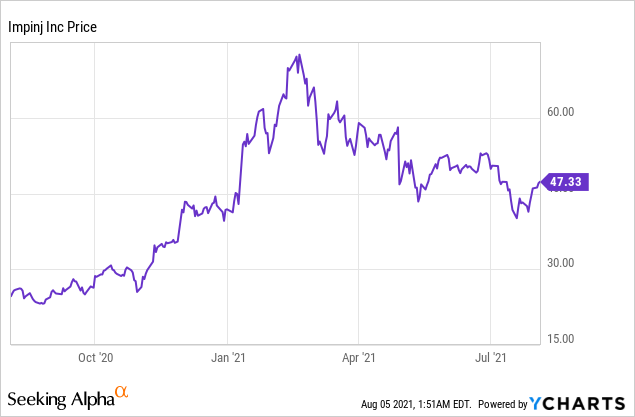
Data by YCharts
Strength
The Company leverages the RAIN RFID technology to offer leading-edge products and solutions for seamless connectivity for the IoT. These enable organizations to improve their efficiency, drive profit and simplify operations.
Impinj product offerings consist of
- Tag Chips that enable unique identification to facilitate smart, connected endpoints
- Reader chips that act as the basis for creation of devices with embedded RAIN RFID read/write capability.
- Readers which identify connected things and
- Intelligent data processing solutions in the form of cutting-edge Software.
The Company has a robust network of partners that are adept at incorporating the company’s game-changing products into solutions for difficult business challenges. Some of Impinj’s product partners include Chainway, Convergence systems limited, Hopeland, BlueBird Denso Wave and Rodin bell among others.
IoT solutions are in great demand, with the market expected to reach 17.4 billion by 2026. The Company’s products and solutions are being deployed in diverse industries to address inventory management, asset management, shipment verification, Aviation, Healthcare, Hospitality and Manufacturing to name a few.
Most recently, in July 2021, Hopeland Technologies, the Company’s gold partner, launched a range of fixed readers, handheld readers, and reader modules built using the E710 RAIN RFID reader chip. Similarly, another gold partner Chainway announced a new range of RAIN RFID products that will incorporate Impinj E710, E510, and E310 reader chips.
The services rendered by the company encompass areas such as identity access management, security analytics, application and endpoint security and intrusion detection and prevention. The technology finds application in a wide variety of industries ranging from automotive, healthcare, banking and financial services and Insurance.
Impinj caters to industry leaders such as Adient, Cisco, Cocacola, Haier, TopGolf and Volvo among others.
The Company has pioneered and co-founded the RAIN Alliance, a global alliance that seeks to further the adoption of UHF RFID technology. RAIN RFID can connect billions of everyday things to the internet and enables the identification, location and authentication of these items.
Impinj has built a very strong intellectual property rights portfolio with over 292 patents issued and allowed as of 31 December 2020.
Weakness
The technology has low adoption rates currently as it involves high purchase and installation costs. There is also a cost involved in maintenance and training employees to understand and implement the solutions. The cost and time involved in implementation of the technology plays a deterrent for many. To install a fully-functional and effective RFID system, companies have to contend with multiple costs including purchase of RFID readers, tags and other related costs such as software, training and integration costs.
There are also many misconceptions and concerns related to privacy of data as the technology is susceptible to interception and external electromagnetic interference.
Opportunity
RFID, which stands for “radio-frequency identification”, involves the capturing and processing of digital data through data waves that are embedded in RFID tags and smart labels. The technology offers improvement over the conventional barcode technology. Barcodes play a very important role in storing and dissemination of product information in numerous sectors. They help in tracking and monitoring solutions, inventory management, supply chain management and even faster checkouts in the retail sector and delivering customer delight. The technology simplifies tracking and inventory management as they become less complicated owing to the use of automation.
Though barcodes are of immense help in managing stock and operations, they come with their own set of limitations such as sometimes they do not scan properly and need to be manually checked, causing a delay in checkout, which may not only take up precious time and slow down the frontline but also mar the customer’s experience.

Image Source: Shutterstock
According to a report by Markets and Markets, the global RFID market which stood at USD 10.7 billion in 2021 is expected to be worth over USD 17.4 billion by 2026, growing at a CAGR of 10.2 percent. The growth will be driven by technological advancements, availability of low-cost RFID solutions and growing demand for RFID solutions in sectors such as manufacturing, retail to drive productivity and government impetus.
However, the industry has been impacted by the COVID 19 pandemic with issues such as supply chain disruptions, cut-back in retail spending, the falling demand for automobiles to name a few. Though governments around the world are mandating RFID tagging for vehicles, the imposition of lockdowns have disrupted the demand for RFID tags. The administration of vaccines on a war footing and the subsequent opening up of the economy may help the industry recover from the setbacks.

Image Source: Company
IoT solutions are becoming extremely crucial as more and more devices use the internet to stay connected and store information online. According to an estimate by MarketsandMarkets, by 2020 there would be over 25 billion IoT connections and this offers a significant opportunity for organizations to improve the delivery of their products and services. The rapid adaptation of IoT is changing the manner in which businesses operate by not only improving outcomes but also reducing costs, time and enhancing efficiency and security.
According to the same report, the global market for IoT solutions and services will reach USD 278.9 billion by 2024, growing at a CAGR of 14.9%, from USD 139.3 billion in 2019, driven by the rapid advancements in wireless technology and increasing decentralization. Companies are increasingly looking at IoT solutions for security, device management, application support and providing services such as real-time monitoring, customized alerts and notifications and access to cloud services. The technology is of particular interest to companies in areas such as manufacturing and transportation as it allows for remote monitoring, predictive maintenance and real-time data analytics.
The growth in the market will be fueled by the growing demand for internet of things devices that are interconnected such as connected cars, smart cities, wearable devices, smart homes to name a few.
Threats
There is a possibility of a new and better technology emerging in the market, which may render RFID technology obsolete. Next-generation asset tracking solutions are rapidly emerging in the market which are based on Bluetooth Low Energy (BLE) and Ultra-wideband (UWB), which offer improvements over the existing RFID technology such as cost-effectiveness, easy implementation, better battery performance and no need for additional hardware.
RFID implementation is still mainly dependent on a human being to oversee and scan items, especially in the retail settings, which leaves a chance for error. Also, the technology has material limitations and does not work well with metals and liquids.
The Company also faces stiff competition from competitors such as NXP Semiconductors in the RFID market, however there are ample growth opportunities for many players in the burgeoning RFID market.
Financial Results
The Company announced quarterly earnings of $0.11 per share compared to a loss of $0.25 a year ago. Revenue stood at $47.27 million for the quarter ended June 2021, as against $26.46 million a year ago. Impinj has surpassed consensus EPS and Revenue estimates four times during the last four quarters.
Chris Diorio, Impinj co-founder and CEO commented,
“Our second-quarter results were strong, exceeding our revenue and profitability guidance. We delivered a record bookings quarter, record adjusted EBITDA, introduced groundbreaking new products, strengthened our team and saw strong demand ahead.”
The Company’s third quarter 2021 financial outlook estimates the revenue to be in the range of $43 to $45 million.
Conclusion
The demand for RFID solutions is here to stay as retailers such as Amazon, Walmart, Nike and Macy’s continue to implement RFID solutions to improve their inventory management, supply chain management and get real-time insights into consumer purchase behaviors. The appeal of the technology is not limited to retail alone, but permeates to other high-growth opportunities such as manufacturing, aviation, automotive and healthcare management.
Unlike competitors such as NXP and ZEBRA, Impinj offers a comprehensive platform which includes Endpoint IC’s, readers, and Reader software.
The Company has ample opportunities for growth and expansion as evidenced by its internal estimates that see a massive opportunity in retail, supply chain & logistics and other fields, which offer more than 21 billion items in 2021 that would be RAIN enabled. Till date the Company has sold more than 50 billion endpoint IC’s and over 3 million connectivity devices and firmly believes that it has a trillion more to achieve.
Disclosure: I/we have no positions in any stocks mentioned, and no plans to initiate any positions within the next 72 hours.
Click here to please visit our detailed disclosure
References
https://www.marketsandmarkets.com/Market-Reports/rfid-market-446.html

No Comments