


19 Nov 6 Reasons to Avoid Atea Pharmaceuticals
Termination of Collaboration with Roche
Atea Pharmaceuticals, Inc. (NASDAQ: AVIR), a clinical-stage biopharmaceutical company, announced the termination of its strategic collaboration with Roche (OTCQX: RHHBY), for the joint development of AT-527, intended for the treatment of COVID-19. The agreement will be terminated on February 10,2022 and upon termination, all rights and licenses will be returned to Atea.
Atea Pharmaceuticals, Inc. (NASDAQ: AVIR)
Market Cap: $716.35M; Current Share Price: 8.62 USD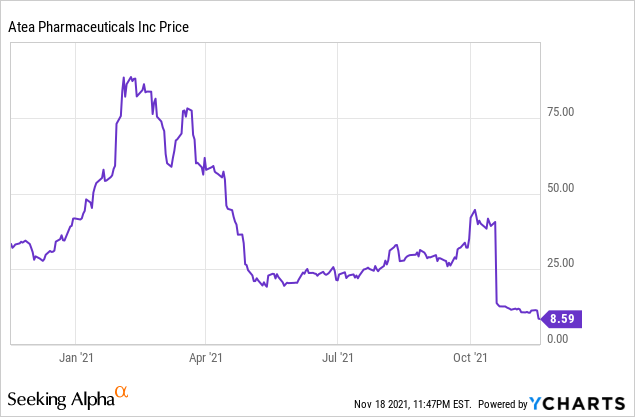
Data by YCharts
Commenting on the development, Jean-Pierre Sommadossi, PhD, Chief Executive Officer and Founder of Atea Pharmaceuticals, stated
“We believe strongly in the potential of AT-527 with its unique dual mechanism of action, antiviral activity against the major variants of concern and its market potential given the need for additional therapeutic options for COVID-19. We have the financial resources and the talent to independently drive forward the Phase 3 MORNINGSKY clinical trial program, and we continue to expect data from this trial during the second half of 2022. We are energized by the opportunity to move forward with full ownership, providing us with autonomy to efficiently bring AT-527 to market.”
Setback in a crucial Phase 2 trial
The Company faced a massive setback in October 2019, with AT-527, an oral direct-acting antiviral, failing to achieve its objectives in a Phase 2 trial named MOONSONG, in patients with mild or moderate cases of COVID-19. The candidate, which was designed to be an easy-to-swallow pill for COVID-19, could not lower the amount of circulating SARS-CoV-2 virus in patients with mild or moderate cases, when compared to patients receiving a placebo.
Atea is currently engaged in an ongoing phase 3 study with 1,400 mild-to-moderate COVID-19 patients namely MORNINGSKY, which it now intends to pursue on its own and is planning on releasing data from the trial during the second half of 2022.
Atea and Roche had originally announced a partnership in October 2020, to develop the first candidate as the first oral treatment option for COVID-19 patients, which had the potential to treat patients early and reduce the progression of the infection.
A Missed Opportunity
According to the World Health Organization (WHO), Coronavirus (CoV) is a family of viruses that cause illnesses ranging from common cold to lethal diseases such as the Middle East Respiratory Syndrome (MERS-CoV), Severe Acute Respiratory Syndrome (SARS-CoV) and a new strain of CoV named, novel coronavirus (nCoV). The virus is Zoonotic as it is transmitted from animals to humans, with the presence of many strains that have not yet infected humans. The infection manifests in the form of respiratory symptoms, cough, fever, shortness of breath and can take the form of pneumonia, severe acute respiratory syndrome, kidney failure and even death.
There is no definite cure or treatment for eradication of CoV, with treatment being limited to alleviation of symptoms, and providing support and care to patients. Scientists have been able to sequence the virus genetic code; spurring organizations around the world into action.
The COVID-19 pandemic is likely to become endemic, similar to the seasonal FLU and countries have already undertaken vaccinations on a war-footing, even in less developed countries. The initial race to create vaccinations is now over, with some emerging as clear winners, while others ruin a missed opportunity.
Atea’s AT- AT-527 has clearly missed the bus as competitor products are already under FDA review and are likely to be approved shortly, while the Company’s best shot at an approval will only come in 2023, provided the candidate is successful in the phase 3 trial and manages to get an FDA approval.
Issues with Trial Design
The failure of the trial was attributed to the study mostly including young and healthy participants, many of whom were already vaccinated and at a very low risk of disease progression. Around one third of the trial’s participants had no underlying health conditions.
Atea stated that the results were more promising in a smaller group of volunteers who were more at risk of developing a severe infection and had an existing health condition. The Company has amended the phase 3 trial design to include more high-risk patients.
While it may improve the chances of success of the drug in the phase 3 trial, there are other more promising candidates such as molnupiravir from Merck and Pfizer’s Paxlovid that are miles ahead of AT-527.
Competitors are Miles Ahead
Pfizer’s has applied for an emergency authorization for PAXLOVID™ (PF-07321332; ritonavir), a 3CL protease inhibitor, intended for the treatment of mild to moderate COVID-19 in patients at increased risk of hospitalizations or death.
The Company’s FDA submission includes data from the Phase 2/3 EPIC-HR (Evaluation of Protease Inhibition for COVID-19 in High-Risk Patients) interim analysis. The candidate has the potential to become the first oral antiviral that could be prescribed as an at-home treatment to avoid hospitalization and death. The data from the Phase 2 trial demonstrated that PAXLOVID was able to reduce COVID-19-related hospitalization or death from any cause in patients by 89%, when compared to a placebo.
Besides the U.S, the company has also initiated rolling submission in the United Kingdom, Australia, New Zealand and South Korea.
In November 2021, Merck’s molnupiravir (MK-4482, EIDD-2801), which is being developed in partnership with Ridgeback Biotherapeutics, was granted an authorization in the United Kingdom, making it the first oral antiviral medicine authorized for the treatment of mild-to-moderate COVID-19 in adults with a positive SARS-CoV-2 diagnostic test and who have at least one risk factor for developing severe illness. The Company plans to launch the drug under the name LAGEVRIO® in the U.K.
Merck has already submitted an application to the U.S FDA for an EUA of molnupiravir and has announced the initiation of a rolling review of the Company’s Marketing Authorization Application by the European Medicines Agency. The interim analysis of the candidate shows that it can reduce the risk of hospitalization or death by approximately 50%.
A limited Pipeline
The Company’s pipeline consists of AT-752, which is currently being evaluated in Phase 1 trials for the treatment of Dengue. The Company had granted Roche Ex-US commercialization rights, which will now revert back to Atea, upon termination of agreement with Roche on February 10, 2022.
Atea is also developing AT-783 for the treatment of Hepatitis C (HPV), but the candidate already faces competition from the likes of AbbVie’s Mavyret. Mavyret is a combination of glecaprevir and pibrentasvir and is used to treat Hepatitis C. The sales of the drug are pegged at $477 million, according to an estimate.
The most advanced candidate AT-527 is likely to post results from the Phase 3 trial in COVID-19 in the second half of 2022, by which time both Merck and Pfizer would have cornered a majority market share. The candidate, even if it succeeds in the clinical trial, will have to submit an application for approval to the FDA and undergo the normal review process, which means that it will only hit the market in 2023.
Conclusion
While some stocks present a buying opportunity on a dip, Atea doesn’t have much going for it at the moment. A failed trial, termination of agreement with Roche and a limited pipeline makes this a risky investment.
Disclosure: I/we have no positions in any stocks mentioned, and no plans to initiate any positions within the next 72 hours.
Click here to please visit our detailed disclosure
References

No Comments