



15 Nov Cogent Biosciences: Massive Upside Potential!
Cogent Biosciences, Inc. (NASDAQ: COGT) is a clinical-stage biotechnology company targeting underlying causes of genetic dysfunction that cause diseases such as cancers, autoimmune disorders and rare diseases. The Company’s lead candidate bezuclastinib (CGT9486), is a precision kinase inhibitor that inhibits the KIT D816V mutation, which is responsible for a rare condition, namely, Systemic Mastocytosis. In addition, the candidate is being evaluated for the treatment of advanced gastrointestinal stromal tumors (GIST).
In October 2021, H.C Wainwright initiated coverage for the stock with a “Buy” rating and a price target of $25, which was later revised to $31, showing a massive upside potential. The star analyst Micheal King opined,
“In addition to the fact that Cogent has acquired a promising molecule in the form of bezuclastinib, the company’s valuation stands only modestly above its cash holdings of ~$218 million, a financial ratio which we have previously observed to be a favorable entry point for a viable company in our sector. We find the company’s technology value of ~$300 million attractive given that bezuclastinib has already shown an intriguing safety vs. efficacy profile in GIST patients, and therefore, we believe has a high probability of success.”
On November 5,2021 HC Wainwright reiterated its buy rating and raised the price target to $31.
Cogent Biosciences, Inc. (NASDAQ: COGT)
Market Cap: $418.44M; Current Share Price: 10.50 USD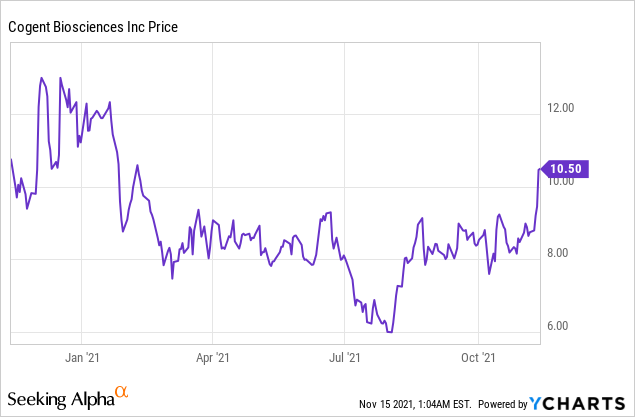
Data by YCharts
Strength
Bezuclastinib is intended to target the exon 17 mutation including KIT D816V, which causes mast cells to accumulate in the bone marrow as well as various organs by being in a perpetual “on” state. The Company has initiated a Phase 2 clinical trial of bezuclastinib for Nonadvanced Systemic Mastocytosis (NonAdvSM) patients and intends to initiate a Phase 3 clinical trial namely PEAK evaluating bezuclastinib and sunitinib for Gastrointestinal Stromal Tumor (GIST) patients, in 2021. The Company has had positive interactions with the FDA and is on track to initiating a Phase 3 trial. The candidate has demonstrated encouraging clinical activity in combination of bezuclastinib + sunitinib in heavily pre-treated GIST patients.
In October 2021, the Company announced preclinical data that shows bezuclastinib as a differentiated, potent, and selective KIT inhibitor at the 2021 AACR-NCI-EORTC Virtual International Conference on Molecular Targets and Cancer Therapeutics. After three days of usage bezuclastinib demonstrated minimal brain penetration with a low brain to plasma ratio, which is a preferred feature for KIT mutant inhibitors. This is an improvement over some of the existing mutant KIT inhibitors that have caused CNS-related adverse events.
The current treatment landscape consists of FDA-approved therapies such as imatinib, sunitinib, regorafenib, and ripretinib, however, 60% of GIST patients develop resistance to imatinib. This presents a large unmet need for a better and improved treatment option.
The Company is currently enrolling patients in a Phase 2 APEX trial of bezuclastinib in patients with Advanced Systemic Mastocytosis (AdvSM) and is planning to announce preliminary clinical data at a scientific conference in H1, 2022.
Cogent has partnered with Serán Biosciences to create an updated formulation of bezuclastinib, which will be used in the PEAK trial and has the potential to reduce the daily pill burden.
Weakness
Strategic Partnerships and collaborations are crucial for clinical-stage companies as they not only bring knowledge and technical know-how but also expertise in navigating regulatory and market hurdles. Tie-ups with major pharmaceutical companies not only serves as a validation of its novel technology and approach but also offers the potential to expand its existing relationship to cover more indications or tie-up with other companies seeking to leverage its unique approach.
The Company does not have any collaborations or partnerships at present.
Opportunity
Systemic mastocytosis is characterized by a buildup of mast cells, a type of white blood cells found in connective tissues in the body, caused by a mutation in the KIT gene. Mast cells play a very important role in the functioning of the immune system; however, an excessive buildup of these cells can cause severe inflammation and organ damage.
Mast cells usually build up in the skin, bones, intestine, liver, spleen and in some rare cases even in the brain, heart and lungs. The disease manifests in the form of itching/hives, abdominal pain, nausea, muscle pain, anemia or bleeding disorders among others. The common triggers include alcohol, spicy foods, insect stings and certain medication. The disorder can lead to complications such as organ failure, blood disorder, anaphylactic shock, peptic ulcers to name a few.
Gastrointestinal stromal tumors (GISTs) are a rare form of cancer that originate in special cells called interstitial cells of Cajal (ICCs), in the walls of the gastrointestinal (GI) tract. The gastrointestinal tract also known as the digestive tract plays a crucial role in processing food and getting rid of solid waste from the body.
GIST’s can start in the stomach or in any part of the GI tract or in some cases even outside the GI tract in the omentum or peritoneum. The tumor can be localized or spread to other parts of the body based on factors such as size, location and mitotic rate. Some of the risk factors for developing GIST include age and genetic inheritance of certain genes such as PDGFRA gene or SDH (succinate dehydrogenase) genes.
GIST’s are different from other types of stomach cancers such as adenocarcinomas, squamous cell carcinomas or neuroendocrine tumors (NETs) as they start in different cells and have to be treated differently. The current treatment options include surgery, targeted drug therapy, ablation and embolization, chemotherapy and radiation therapy.
According to a report by persistence market research, the global Gastrointestinal stromal tumors (GISTs) market will be worth over $1.5 billion in 2026, growing at a CAGR of 6.6% from 2017. According to the WHO, GIST’s are the most common primary mesenchymal tumors of the gastrointestinal tract and are found in 14.5 per million, with a prevalence 129 per million, and 5000 to 6000 new diagnoses per year in the United States.
Threats
Clinical Trials are fraught with risk and uncertainty. There is a possibility that the candidates in the Company’s developmental pipeline may not be able to meet their clinical endpoints in trials. However, a diverse pipeline will help mitigate the risk in case of adverse results or the failure to meet endpoints in any of its ongoing trials. The success of its clinical trials will help the Company advance its pipeline but it should also be prepared to face any setbacks, in case its ongoing trials fail to meet their endpoints.
Key Takeaways
Disclosure: I/we have no positions in any stocks mentioned, and no plans to initiate any positions within the next 72 hours.
Click here to please visit our detailed disclosure
References
https://finance.yahoo.com/news/cogent-biosciences-provides-corporate-updates-120000930.html
https://investors.cogentbio.com/static-files/0ab4e5d3-7fa0-4e73-a7ba-d497c7bf2923

No Comments